VoIP
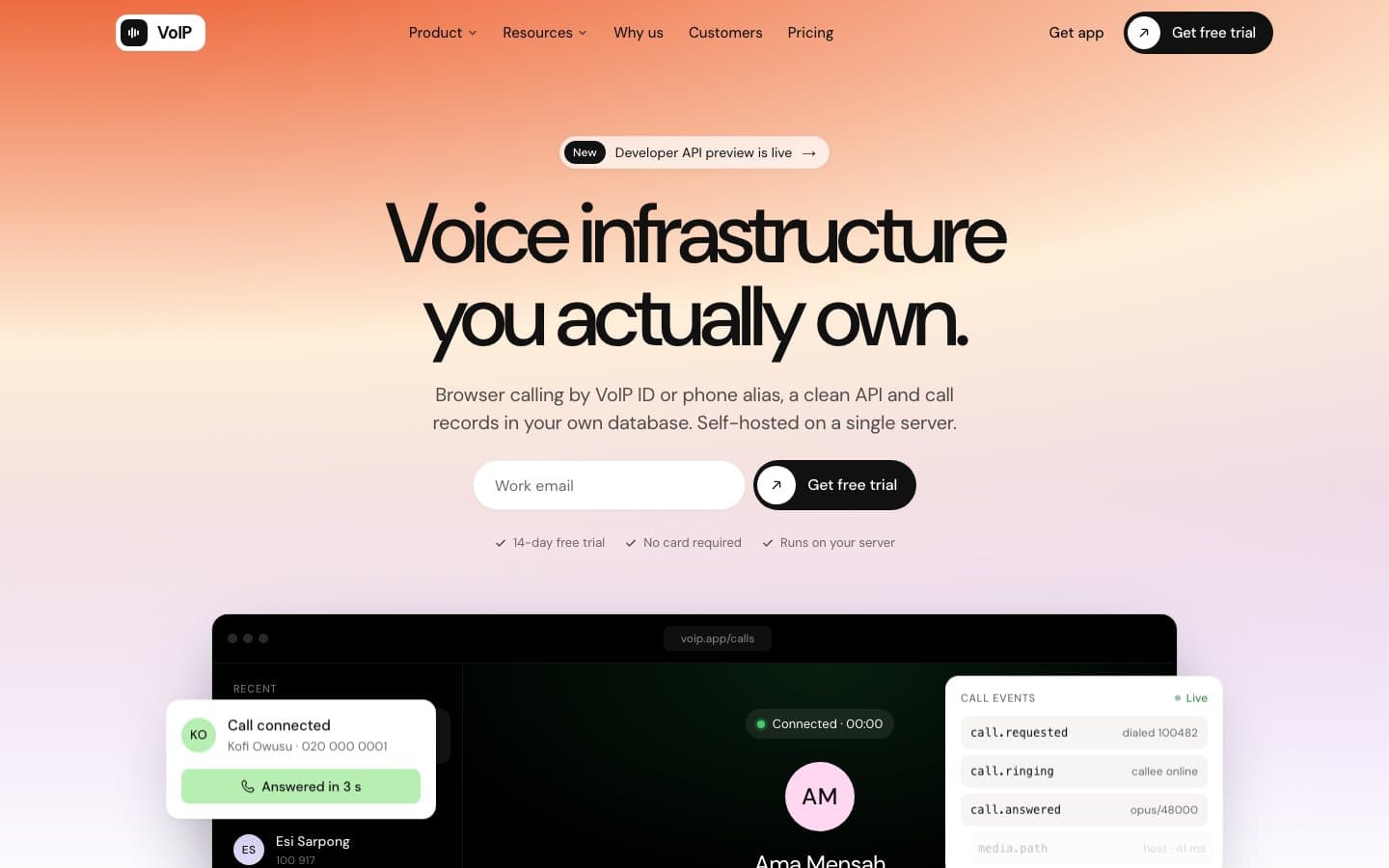
Voice infrastructure you actually own: browser calling by VoIP ID or phone alias, a clean API and call records you control, self-hosted on a single server. Built from scratch.
- Role
- Architect / Engineer
- Category
- Voice infrastructure
- Year
- 2026
- Status
- API preview live
The brief
Adding calling to an app usually means renting someone else's voice platform, so your routing, your call records and your customers' data live on their servers. VoIP is the opposite: voice infrastructure you run yourself, with the control that comes with it.
What people get
Browser calling by VoIP ID or phone alias. A clean API. Call records in your own database. All of it self-hosted on a single server, with SDKs for the web, Node, React Native and Flutter.
How a call works
Your server issues a short-lived token. The Web SDK places the call from the browser. Asterisk bridges it. Coturn relays the audio when a direct path isn't possible. A signed webhook tells your server what happened.
I built it from scratch
The API and tenancy model, the SDKs, the website and calling app, and the Docker Compose stack that runs the voice engine, from the browser to the database.
The hard part is the network
Voice is a networking problem wearing an application costume. A first build silently left out a database module because one library was missing. Browser contacts weren't being rewritten behind NAT. Endpoints weren't being checked, so every one looked offline and every call would have been rejected. Each of those was found by rehearsing the full stack, not by reading code.
How it's built
- 01Browser callingCall by VoIP ID or phone alias
- 02API + sdksTenant-scoped, short-lived tokens, call grants
- 03Integrations + webhooksSigned webhooks, call records you control
- 04Voice engine + relayAsterisk 22 (PJSIP, ARI) · Coturn STUN/TURN
- 05PostgreSQL 16Tenants, call history, realtime config
Top: what the user touches. Bottom: what holds it up.
Key decisions
Provisioning is a one-shot job
Migrations and provisioning run in a separate container, so the owner-level database credentials never sit inside the long-running API.
Pin everything
Images are pinned to exact versions, and the Asterisk source is checked against the publisher's SHA-256 before it's built.
Fail safe on reconnect
If the control connection to the voice engine drops, affected calls end and unfinished records are marked orphaned, rather than the system guessing what happened.
Test against a fake engine
Call-controller scenarios run against an engine-neutral fake, and a separate stub exercises the real adapter. 40 tests run in the suite, and the PostgreSQL ones run against a disposable database.
What I learned
Most of the bugs weren't in the application code. They were in the network, the build and the configuration around it.
Stack
- Node.js
- TypeScript
- Asterisk
- WebRTC / SIP
- Coturn
- PostgreSQL
- Docker Compose
- Caddy
- Oracle Cloud (ARM)
Screens